

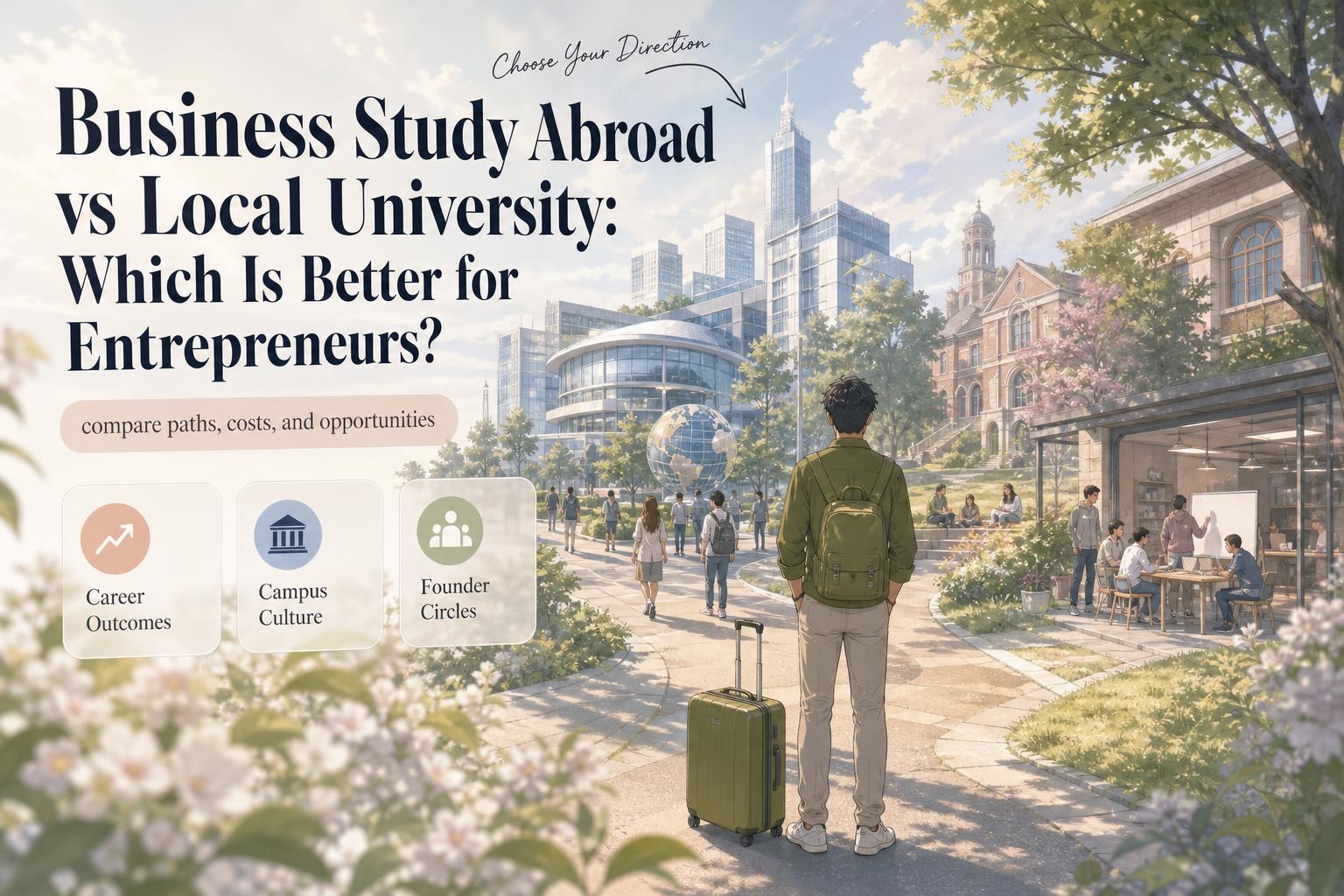
You have an offer from a business master's program in Toronto, a prototype with a dozen paying customers back home, and enough savings to fund one of them. For a founder, that is the real business study abroad question. Our answer: a local university wins for most entrepreneurs, and a full degree abroad wins only when the business itself is cross-border. If you sell into foreign markets, source from foreign suppliers, or build around another country's regulation, living there gives you something no campus at home can. Everyone else does better staying local and buying international exposure in smaller, cheaper pieces.
That position runs against how study abroad is usually sold. The mobility data is strong on exposure and access. It does not show that studying abroad causes better startup outcomes. A degree abroad can put you in the right room. It cannot make the company work. For a founder, the money spent on tuition is money that does not go into product, a first hire, or another six months of runway.
The short version
For most founders, a local university is the better choice. It costs less, keeps you close to domestic customers and investors, and lets you keep operating the business while you study. A full business degree abroad is worth it when your company depends on international customers, foreign suppliers, cross-border regulation, or a specialized ecosystem you cannot reach from home. The hybrid route sits in between: a local degree plus a semester abroad, an international internship, or an accelerator. It gives you most of the exposure at a fraction of the cost.
What each path feels like from the inside
The brochure version of a degree abroad is seminars, a new city, and classmates from forty countries. For a founder, the first semester looks different. You spend it opening a bank account, finding housing in a market where landlords want local guarantors, waiting on a residence permit, and answering customer emails six or nine hours out of sync with your own market. Call it the setup tax: every hour spent becoming a legal, housed resident is an hour not spent on the company. Founders who arrive with a business already running pay the most of it.
The local path is quieter, and that is its advantage. Your customers are a train ride away. Your family may cover rent or meals. Investors who know your market can meet you for coffee without a flight. If the company needs you during exam week, you can still show up. People rarely talk about this when they romanticize going overseas, but a founder who can keep shipping while studying has an edge over one who has to pause for two years.
Living abroad does build something real. You learn how procurement works in another country, how customers there negotiate, and what a foreign regulator actually asks for. Some of that knowledge only comes from being there, and for the right business it is worth the setup tax several times over. For a founder selling to customers at home, most of it is interesting but not decision-relevant.
The money, worked out for one founder
Headline tuition is the wrong number to compare. The comparison that matters is the total cost of education and relocation against what that same capital could do inside the business.
Take a founder weighing a two-year master's in Canada. The OECD benchmark puts public-institution tuition for international master's students at $20,876 a year as of 2026. On top of that, Canada requires about $16,771 a year in demonstrated financial means for the study permit. Together that is $37,647 a year, or roughly $75,300 over two years. And that figure is a floor. The OECD tuition benchmark excludes housing and travel, and the financial-means figure is what the government wants to see in your account, not what a year in Toronto actually costs. Flights home, deposits, insurance, and laptop replacements all come on top.
Now set that $75,300 against runway. If a solo founder can live and operate lean on $4,000 a month (an assumption you should replace with your own number), the degree equals about 19 months of full-time building. We call this the runway-equivalent cost: price the degree in months of company life you give up. A degree has to beat 19 months of focused work on the business to pay off on these terms. Sometimes it does, especially when it brings a visa, a market, or co-founders you could not otherwise reach. Often it does not.
Here is how the main destinations compare on the same two components:
| Destination | Annual international master's tuition (2026 benchmark) | Required annual visa financial means | Minimum annual total |
|---|---|---|---|
| Germany | About $157 administrative fee (same as domestic students; exceptions by state or institution) | $14,067 | About $14,224 |
| France | $5,592 | $8,721 | $14,313 |
| Netherlands | $20,328 | $16,035 | $36,363 |
| Canada | $20,876 | $16,771 | $37,647 |
| Australia | $20,880 | $21,124 | $42,004 |
| United Kingdom | $12,134 to $40,446 | $14,209 outside London, $18,553 in London | $26,343 to $58,999 |
The range in that table is wider than most founders expect. A year in Germany or France costs roughly a third of a year in Australia, and the cheapest UK option is less than half of the most expensive London one.
Study level matters too. The OECD's Education at a Glance 2025 found that master's tuition ran 29% above bachelor's tuition on average across member countries. That same report counted 12 of 18 OECD countries with available data where foreign students paid more for a master's than domestic students did. In practice, the passport you hold can change the price of the same seat.
The visa minimums are not a living budget. Our cost of living and housing guides exist for exactly that gap between what a government asks you to prove and what a year in the city actually costs. Close that gap before you sign anything.
The debate in public forums lands in the same place. On X, people weighing a large sum for a degree abroad against starting a business frame it as long-term signaling and network value versus immediate capital. On r/Indians_StudyAbroad, prospective master's students raise a sharper worry: debt-financed study abroad becomes unsustainable fast when post-study work or immigration outcomes don't come through.
Warning: If you are borrowing to study abroad, run the numbers on the outcome where you get no post-study work visa and come home after graduation. If the debt is manageable in that case, the decision is defensible. If it only works in the best case, you are making a leveraged bet on immigration policy.
Where studying abroad genuinely wins
A full degree overseas has a real advantage for founders whose business model points outward. Consider importers building supplier relationships in a foreign manufacturing region, fintech founders whose product depends on another jurisdiction's licensing rules, or B2B founders whose first customers will be in a market they don't yet understand. For these founders, two years inside the target country is market research and network-building that also happens to end in a credential.
The classroom itself is also more international at higher levels. The OECD's international student mobility data shows international students made up 11% of new bachelor's entrants across member countries in 2024, then about a quarter of new master's entrants, and just over a third of new doctoral entrants. A master's cohort abroad is far more likely to include future partners from several markets than an undergraduate lecture hall.
Some of the appeal goes beyond the campus. Commenters on r/ThirtiesIndia argue that doing business abroad can make sense because of licensing, permitting, and administrative efficiency, not only lower costs. For a founder in a heavily regulated sector, a degree that leads to residence in an easier jurisdiction can change how fast the company moves.
The ecosystem argument has limits. A famous startup city is only one input. Visa reliability, post-study work rules, housing availability, the university's career office, and whether its incubator has room for one more team all decide whether the move pays off. A strong ecosystem you cannot legally stay in after graduation is worth less than a smaller one you can.

Where the local university quietly wins
The common objection to staying home is that it narrows your world. That holds less often than people assume, because international students come to you.
American campuses alone hosted 1,177,766 international students in 2024/25, up 5% on the year before, according to IIE's Open Doors 2025 release. The useful detail for founders is what those students study. Fifty-seven percent were in STEM fields, with 26% in mathematics or computer science and 18% in engineering. Only 14% were in business and management. A business student looking for a technical co-founder with ties to another market is more likely to find one in the computer science building down the hall than in a business school abroad full of other business students.
The pattern holds outside the US. Across OECD countries in 2024, international graduates earned STEM degrees at a higher rate than domestic graduates, 30% against 23% (Education at a Glance 2026). Wherever you study, the international students on your campus skew toward the technical skills founders tend to lack.
Beyond that, the local case is the plain one: lower total cost, knowledge of the domestic market, relationships you already have, family support, and the ability to keep running the business. A founder with traction at home who leaves to study for two years is giving up the one thing that is hardest to rebuild.
The muddy middle: exposure without the diploma
Most founders don't need to choose between everything abroad and nothing abroad. International exposure and an international degree are separate things, and you can get the first without paying for the second.
The hybrid route is already the norm. Open Doors counted 298,180 American students earning academic credit abroad in 2023/24, a 6% rise. Of those, 64,627 were studying business and management, just over a fifth of all participants and the largest single group. Even so, only about one US undergraduate in ten studies abroad at any point during the degree. That leaves room for founders who plan the time abroad deliberately.
The options vary in what they give you:
- A semester abroad at a partner school in your target market, used to interview customers rather than to sightsee.
- An international internship with a company that already sells where you want to sell.
- An accelerator or incubator residency abroad, which can be more useful than any coursework.
- An exchange program timed to a trade fair or regulatory cycle in your sector.
- A cross-border capstone project built around a real problem for a foreign client.
Each of these costs months, not years, and none requires carrying two years of overseas living costs on top of tuition.
Tip: Go into a semester abroad with one business question you need answered, such as "Will German mid-market buyers pay for this?" or "Which Dutch logistics firms would pilot this?" Five months of customer conversations in the market is worth more to a founder than a transcript full of elective credits.
Planning a one- to six-month stay brings its own spreadsheet: rent, coworking, health cover, visa type, flights. Do it carefully, but the stakes are much lower than committing to a full degree.
Visas are part of the business plan
Founders tend to treat the visa as paperwork to handle after admission. It is closer to infrastructure. Your post-study work rights decide whether you can legally build the company where you studied.
In the US, post-study work routes are getting heavy use. Optional Practical Training participation grew 21% to 294,253 in 2024/25, per Open Doors. At the same time, the arrival pipeline is thinning. First-time international enrollment fell 7% to 277,118 that year, even as total international enrollment approached 1.2 million. More graduates are using the work route while fewer new students arrive, which is the kind of mixed signal that should make a founder read the current rules for their specific destination rather than rely on last year's forum posts.
Experience reported on r/Indians_StudyAbroad matches this: students and graduates describe outcomes that vary sharply by destination, visa pathway, institution, and personal circumstances. Asking coworkers or expat groups is a reasonable place to start, but their experience reflects the rules in force when they went.
One more point. Employees on work-from-anywhere policies can often rely on their employer's immigration or tax team. Founders usually have no such team. No general guide can answer your company-specific compliance questions, including ours, so budget for an immigration lawyer before you commit to a founder or startup visa route.
If you do go: choosing a country and a program
Business study abroad covers several fields: international business, business analytics, global trade, finance, marketing, logistics, and strategy, offered at bachelor's, master's, and doctoral level. Undergraduate entry straight after secondary school is common. For founders, though, the master's level usually gives the best mix of international classmates and shorter duration.
Program directories tend to make options look interchangeable. A business analytics master's in Portugal and a management degree at Lancaster University in England can look similar on a listing page. Compare them on founder criteria instead:
- Does the city have your customers or suppliers?
- Does the university run an incubator that admits student teams, and how many teams does it take?
- Can you reach mentors who have founded companies, not only lecturers?
- What post-study work right does the country offer, and how stable has it been?
On cost, Germany and France stand well apart from the rest, with minimum annual totals near $14,000. Canada, the Netherlands, and Australia cluster between about $36,000 and $42,000. The UK spans the widest range, depending on the institution and whether you live in London.
Career paths from these programs include trade and supply chain roles, analytics and consulting, and corporate positions in multinational companies. For founders, though, the career outcome that matters most is usually the company you leave with, or the co-founder you leave with.
The recap
| Option | Best for | Typical cost |
|---|---|---|
| Local university | Founders with domestic customers, existing traction, or family support who need to keep operating | Domestic tuition; see site for your institution |
| Hybrid: local degree plus semester, internship, or accelerator abroad | Founders who want market exposure without two years of relocation | Domestic tuition plus several months of overseas living costs |
| Full degree abroad, low-cost destination (Germany, France) | Cross-border founders on a tight budget | Roughly $14,000 to $14,500 a year minimum |
| Full degree abroad, mid-cost destination (Netherlands, Canada, Australia) | Founders targeting those specific markets or post-study routes | Roughly $36,000 to $42,000 a year minimum |
| Full degree abroad, United Kingdom | Founders needing UK market access or a specific institution | Roughly $26,000 to $59,000 a year minimum |
Choose a degree abroad if your business only works across borders: foreign customers, foreign suppliers, foreign regulation, or a specialized ecosystem you cannot reach from home. Pick the destination by post-study work rights and incubator access first and by city reputation second. Start with Germany or France if the cost table puts pressure on your runway.
Choose a local university if your customers, investors, and support network are at home, or if you already have a business you cannot pause. Then add a semester, internship, or accelerator abroad aimed at the one market question you need answered. If a friend with a prototype and some savings asked us, that is what we would tell them: stay local, keep the capital in the company, and spend months abroad, not years, exactly where the business needs them.
Frequently asked questions
Is studying business abroad worth it for entrepreneurs?
It is worth it when your business depends on international customers, foreign suppliers, cross-border regulation, or a specialized ecosystem abroad. For founders focused on their home market, a local degree usually delivers more because it costs less and keeps you near customers and investors. Current evidence shows that study abroad increases exposure and access, but it does not prove that studying abroad causes better startup outcomes.
What is the cheapest country to study business abroad?
Germany and France are the cheapest of the major destinations. Germany generally charges international master's students the same as domestic students, with an administrative fee benchmark around $157, plus about $14,067 in required annual financial means. France's benchmark is $5,592 in tuition plus $8,721 in financial means. Both figures exclude flights, and real living costs often exceed the visa minimum.
Can I study business abroad straight after secondary school?
Yes. Many universities admit international students directly into business bachelor's programs. Across OECD countries in 2024, international students made up about 11% of new bachelor's entrants, compared with 24% at master's level. For founders, a master's abroad often gives a more international cohort in less time, while a local bachelor's plus an exchange semester keeps costs down.
What does a business analytics or international business program cover?
International business programs typically cover global trade, strategy, marketing, finance, and logistics across markets. Business analytics programs focus on data, modeling, and decision-making with quantitative tools. For a founder, the curriculum matters less than the access around it: incubators, mentors, internships, technical classmates, and customers in the host market.
Do I need a full degree abroad to get international business experience?
No. A local degree combined with a semester abroad, an international internship, an accelerator residency, or a cross-border capstone gives much of the same exposure at a fraction of the cost. In 2023/24, business and management was the largest field among US students earning credit abroad, at just over a fifth of all participants, which shows how common the hybrid route has become.
Related Reading
- Top 10 Business Study Abroad Destinations for Future Entrepreneurs
- 7 Ways to Turn Study Abroad Into an International Business Launchpad
- Business Study Abroad vs International Internships: Which Builds Better Careers?
- Study Abroad Business Programs: A Guide to Costs, Visas, and Housing
- 9 Business Study Abroad Mistakes That Can Derail Your Plans
- 11 Business Abroad Tips That Actually Work for First-Time Founders
- Can I Open a Business Overseas? A Practical Planning Guide
- How to Do Business Abroad While Staying Compliant With Local Laws

8 Business Study Abroad Program Alternatives (2026)
October 18, 2026 at 4:32 pm[…] Business Study Abroad vs Local University: Which Is Better for Entrepreneurs? […]